/59748.tmb-300v.png?sfvrsn=9885965b_2 "For the future - publication thumbnail")

/countries/china/interview-with-local-farmers2.tmb-1920v.png?sfvrsn=a2e7852f_3)
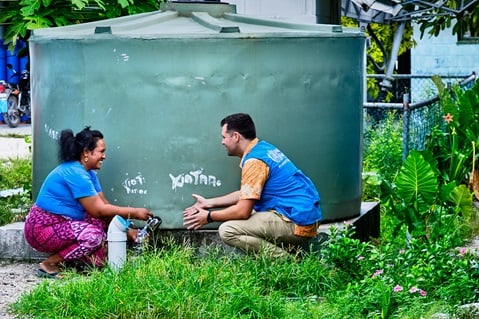
Dr Zhou interviews farmers in China.
A champion for One Health
collaboration and the power of science:
Meet Dr Zhou Xiao-Nong
At a time of increasing pushback on the very tenets of science and medicine, the role of champions advocating for collaboration in public health – and especially a One Health focus – is more crucial than ever.
Ahead of World Health Day 2026, which takes place on 7 April, we interviewed Dr Zhou Xiao-Nong, Chief Scientist at the National Institute of Parasitic Diseases at the Chinese Center for Disease Control and Prevention (CDC) - a World Health Organization (WHO) collaborating centre. Dr Zhou is a member of the One Health High-level Expert Panel that advises the One Health Quadripartite (comprising of the UN Food and Agriculture Organization, the UN Environment Programme, WHO and the World Organisation for Animal Health). Our conversation revolved around the contribution of science and partnerships in advancing health outcomes, both in China and globally.
Q. How have public perceptions about the role of science in health changed over time? And what can we do – as scientists, doctors, WHO and its partners – to safeguard science and advances made in science and medicine?
Public perception of science’s role in health has undergone a profound paradigm shift where even the definition of health has been revolutionized. We’ve moved beyond the “medical model” – where health was simply the absence of disease – to a holistic, bio-psycho-social reality. Today, health is a state of complete physical, mental and social well-being.
Technology has empowered the public, shifting people from passive observers to active, critical evaluators of their own health. We’ve also seen the shift in how sectors collaborate, with the evolution of a collaborative, multisectoral and transdisciplinary approach that we now refer to as “One Health”.
This new reality demands more transparency – like sharing raw data and research methods – and more collaboration - as seen in WHO’s global network of 800+ collaborating centres that turn scientific progress into real-world health benefits. The network enables professional institutions to conduct high-quality surveillance and research, provides a solid evidence-based foundation for global health policy, and ensures that scientific progress translates into tangible health benefits.
Q. From your own career, can you share examples that illustrate how science has advanced health outcomes?
Scientific intervention has played an essential role in improving global health outcomes, from eliminating diseases such as lymphatic filariasis to developing anti-malarial drugs. China’s journey offers a powerful blueprint for how science and global partnerships can promote “Health for All”.
Pioneering diseases elimination: By combining systematic epidemiological research with targeted mass drug administration, China became the first country to eliminate lymphatic filariasis in 2007. This model didn’t just save lives domestically; it was incorporated into WHO’s global gold standard for elimination of this long neglected tropical disease, providing a replicable model for countries around the world.
Enabling medical breakthroughs: Through the development of life-saving drugs like artemisinin and pyronaridine, Chinese scientists turned the tide against malaria, leading to the country’s official malaria-free certification in 2021.
Modelling innovative surveillance strategies: China’s “1-3-7 response model” – report in one day, verify in three, respond in seven – has revolutionized outbreak management. Reflective of the crucial role of scientific management strategies in disease outbreak response, this model has been formally incorporated into WHO technical guidelines and promoted globally.
Promoting cross-border collaboration: Recognizing that diseases don’t respect borders, the National Institute of Parasitic Diseases at the China CDC, in collaboration with WHO and regional partners, established the Asian Network for Schistosomiasis and other Zoonotic Helminthiasis (RNAS+) to address tropical diseases with cross-border transmission characteristics. By bridging countries through shared research, early-warning systems and multisectoral talent training, the Network has curbed disease transmission in the region – modelling regional cooperation for global health governance.
/countries/china/one-health-apprach-design-in-the-schisto-field2.tmb-1920v.jpg?sfvrsn=94fc791_1 "One Health approach, China")
Dr Zhou applies the One Health approach while on field work for schistosomiasis.
/countries/china/field-surveillance-data-evaluation2.tmb-1920v.jpg?sfvrsn=6f04537b_2 "One Health approach, China")
Dr Zhou in a field surveillance data evaluation in China.
/countries/china/in-schistosomiasis-filed-for-suiveillance-work2.tmb-1920v.jpg?sfvrsn=9f286e63_1 "One Health approach, China")
Schistosomiasis field surveillance work.
/countries/china/working-in-the-field-lab2.tmb-1024v.jpg?sfvrsn=6fc7e858_1 "One Health approach, China")
Working in a field laboratory.
Q. Can you describe the importance of WHO collaborating centres (such as the National Institute of Parasitic Diseases) in advancing science for health?
WHO collaborating centres are key nodes in the global health governance system, serving as hubs connecting global strategy with local action.
The development trajectory of the National Institute of Parasitic Diseases, or NIPD, exemplifies this. It transitioned from a domestic parasitic disease control agency in 1980 to a global technical hub for tropical diseases as a WHO Collaborating Centre for Tropical Diseases in 2015. In this role:
- NIPD shares China’s success in malaria and schistosomiasis elimination with other endemic countries, transferring knowledge and providing technical support;
- it promotes research cooperation and information-sharing through collaborative platforms, including RNAS+, to synchronize and advance international elimination efforts; and
- it enhances the voice and influence of developing countries in the field of operational research on tropical diseases through expert policy briefs and the journal Infectious Diseases of Poverty.
Q. Can you share how NIPD has partnered with WHO to advance regional priorities and the outcomes of WHO’s Fourteenth General Programme of Work (GPW 14)?
As a WHO Collaborating Centre for Tropical Diseases, NIPD is tightly aligned with WHO’s goal of eliminating malaria and neglected tropical diseases, or NTDs, in the Western Pacific Region. By maintaining high-level laboratory testing capabilities, conducting surveillance of imported cases and assessing microscopy quality, the Centre consolidates achievements made in eliminating NTDs. It also provides technical support to countries across the Region to address the disease burden of malaria, schistosomiasis, echinococcosis and other parasitic diseases.
NIPD utilized its status as a WHO collaborating centre to launch the China-Africa Malaria Control Cooperation Project. Instead of simply donating drugs, NIPD exported its scientific 1-3-7 surveillance-response model, adapting it to local contexts, resulting in a malaria burden reduction rate of 80% in local settings.
NIPD has also provided technical training, established surveillance systems and conducted field interventions across countries, thus contributing to GPW 14’s goal of ensuring equitable access to health services and reducing health inequities between countries.
Additionally, NIPD set up the Greater Mekong Subregion joint-laboratory network on tropical diseases in 2021, which enables collaboration across Cambodia, the Lao People’s Democratic Republic, Myanmar, Thailand and Viet Nam. These collaboration efforts have strengthened global partnerships and promoted cross-border preventive efforts for tropical disease elimination.
/countries/china/working-in-the-field-with-local-governmental-officers2.tmb-1920v.jpg?sfvrsn=ba3d5e6f_1)
Q. What advice would you give to young people seeking to become scientists, doctors or public health professionals in this day and age? What would you tell them?
My advice to young professionals is to focus on cultivating a few core competencies.
First, have a systems approach to thinking and a cross-sectoral vision for your career. Modern health issues are highly complex, and a single-discipline perspective is insufficient. You must be willing to break through disciplinary barriers, actively integrate knowledge of epidemiology, data science, molecular biology, epidemiology, ecology and sociology, and cultivate a systems way of thinking based on the One Health concept.
Second, nurture a scientific spirit. Science hinges on seeking and verifying the truth. You need to apply a critical thinking lens to your research and dare to question authority. Commit to finding and solving scientific questions to real-world problems.
Third, master cross-cultural communication and collaboration. Public health work in the context of globalization requires extensive international cooperation. It is an asset to have cross-cultural communication abilities, mastery over international languages and experience with international cooperation projects.
Finally, uphold ethical awareness and social responsibility. Scientific progress must ultimately serve human well-being and health equity. So, pay attention to the ethical boundaries of research and the fairness of the distribution of results. Commit to solving health issues affecting the most vulnerable populations and practise the core value of “Health for All”. Your career trajectory must go beyond professional obligation to encompass global health equity.